Archiving in the age of Super Abundance

On the 13th February, the British Film Institute held an event titled ‘Archives in the Age of Super Abundance’. The event was hugely popular and boasted an interesting programme, with a range of speakers from outside the profession, inside the BFI and a few somewhere in between. It looked like the event would tackle some of the problems faced when archiving huge amounts of information, specifically from the online moving image sector. What the event actually did was leave delegates with a sense of impending doom, the feeling that the work ahead was too hard and there was little point in attempting the challenges ahead. Besides this, it also questioned the fundamental meaning of an archive and provided dangerous advice for those working on their own collections within their own communities.

The day began with a welcome with explained the event was held to promote a project the BFI were undertaking to archive 400 online moving image films and make them available as part of their collections. The final panel of the day talked about how this was being achieved and the challenges they were facing. The honesty used in describing these challenges was impressive, but the tone held an overall sense of defeat. That they had no idea how they would move on from this, as capturing the 400 is proving so difficult and that this did not bode well for the future.

George Oates from the Flickr foundation gave the Keynote presentation, which was arguably the most useful session of the day. George is a really engaging speaker who focused on the social and community aspects of archiving, explaining that Flickr split their metadata into technical and social, a novel approach. I struggle to see the different between this approach and the split we already have between technical and descriptive. The same data is captured, it is just labeled differently. George also mentioned the idea of ‘citizen led documentation’ as a specific Flickr approach. Archives don’t use this terminology, but we are trained to capture the social and cultural aspects of our collections. We are standards led because we have to be, but this doesn’t erase the social or the cultural from the work we do. I think Flickr are far more similar to the rest of the sector than they think and are perhaps not the catch all solution to the archives cataloguing and preservation issues that they seem to be suggesting. The admission that the data lifeboat service has been created as the site is now too big to be archived proves this point.

The next two panel sessions were very interesting but held no relevance to the archive. The topics discussed, although interesting were so far removed from the archive process that preservation of anything (super abundant or otherwise) was not discussed. Interesting, but pointless.

Next up was a panel on terminology which focused on how to define the video essay. Should it be a genre, should it be a form, should it be something else? This was a great example of how we set and use standards to tie ourselves up in knots. It really highlighted that our job is difficult, and this is not always expressed well by us.

Then, for me, it all went horribly wrong.

The community archives panel, a welcome inclusion to the event, was titled, ‘The internet is the archive’. This blatantly wrong, factually incorrectly titled panel started with the Chair explaining how her interaction with the community archives on the panel had made her rethink the definition and role of the archive. We heard from three very impressive community archives who were doing marvelous things with the collections they were curating online. I think that the community archive world is fantastic, the work they do and the passion they have for their topics is second to none and it is imperative that this work is preserved so it can be accessed and learned from for a long time to come.
This is why I think defining these collections as archives in harmful. These collections are fantastic. But they are stored online, in some cases uploaded to Instagram or YouTube. This is not preservation, in any sense of the world and for something to be archived, it needs to be preserved. I would argue that it doesn’t need to be catalogued or made available to be an archive, but it does need to be preserved. These are curated collections and to describe them as anything else is dangerous as it implies a false sense of security that having this important content online somehow saves it for posterity. We should be providing advice and guidance for these community group to be preserving their own collections in a way that means they will be safe well into the future. We don’t need to be taking these collection into our holdings (unless the group themselves wants this). We need to support the community archive sector as much as we can, a difficult ask in itself given our own resource and budget issues), but this cannot be at the expense of the collections. They are too important to ignore their preservation for access. There will be no collections to access if they are not preserved and we need to share the skills needed to do this.

With the final panel focusing on the BFI project and its challenges, the day ended on a pessimistic note, which was a shame as the BFI project sounds really interesting and deserved a more optimistic approach. It felt like the plan for the day was to take delegates through the journey of online film, from creation to end preservation, but much of this was largely irrelevant for those expecting discussion and perhaps guidance on how to preserve their own collections. Defining the internet as an archive is a dangerous statement and future events and output from the BFI needs to take the needs of the records into consideration. Changing the fundamentals of our sector cannot come at the expense of the collections we preserve.

World connections, business and multimedia infographic design.

These events are so important to our sector and I hope they continue to be held. But the focus needs to be on the collections, the work we do and how we can help other groups who want to work on their own collections do that. The rest, is really just background noise.


Advocacy – For you and me

For me, being an archivist or a record keeper is a vocation more than a profession. However you stumble across the sector, you stay for a love of the collections, the people you work with and the stories you can tell. However, although we are really good at promoting the collections in our care, we are not so good at advocating for our collections, and for ourselves as archivists. Advocating for enough resources to properly collect our collections tends to come second to us trying to do everything. This blog looks at some ways we can make changes to the current status quo, both or ourselves and for the wider record keeping sector.

Business team putting together jigsaw puzzle isolated flat vector illustration. Cartoon partners working in connection. Teamwork, partnership and cooperation concept

The one thing that we as a sector need to get better at is advocating for ourselves and our collections. We know the importance of the records in our care, it’s why we do the job we do. But not everyone understands the importance of the work we do and the collections we preserve. And this means that the time required to complete the tasks involved in our role is also in most cases underestimated. Our diligence and desire to properly protect the records in our care and do a good job means that we take on far more work than is possible during our contracted hours and somehow complete what is asked of us, in many cases at great cost to our personal lives and in some cases, our mental health. But how do we stop this?

Stop doing it all

Some responses when I’ve brought this up in conversation include, ‘If I don’t do it who will? Or ‘It’s just a busy time just now, it will go back to normal soon’. Or ‘it’s in my job description so I need to do it’. It’s at this point we should remember that we all have someone above us. We are not the be all and end all at the organisations we work for and yes, we have a responsibility to the collections in our care, but we cannot preserve them to our own detriment. If work not getting done is what it takes for those above us to realise, they are under resourced, then so be it. Busy times never get easier, when you work over your capacity, that becomes the norm, you are setting your new expected work level and yes it might be in your job description, but it’s not in that description, or your contract that you need to work yourself into the ground to get everything on the list done. This is the beginning of advocating for yourself. I’m not suggesting that you stop working. I am saying that you work with your management to prioritise tasks, do what is possible within your contracted hours and enjoy your free time. Making it clear what work is required, and staying firm on what you as one person can and can’t do, helps highlight the labour involved in what we do and shows that the investment in additional resource is worthwhile.

Keep Speaking Up

Once you start on this journey, it will become easier to continue to keep advocating for yourself. The ripple effect this will have on the sector will hopefully be widespread. Having examples of similar organisations with good resource levels and work plans will give those struggling examples to point to. The effect of the ARA pay and salary guidelines has been huge since they were implemented. We can achieve more as a group than we can individually. Keep talking to each other and if something doesn’t feel or look right, speak up. Let’s help each other.

Lets Get Digital – Or Should We?

Let’s get Digital! – Or should we?

Previous blogs talked about the ever-changing archive sector and no change has had a more dramatic impact than the development of technology and the establishment of digital archive work. Digital Preservation very quickly became another millstone around the neck of archivists along with the acquisition, appraisal, cataloguing, conservation, access, promotion, advocacy, research and any tasks as appropriate work we were already doing. But should this be the case? Has it got to the point that digital preservation (and maybe other aspects of digital work) has become so large that specific roles should be created to carry out this work? Should digital preservation be its own sector completely? That’s the topic of the musings in this blog.

The unofficial start of the digital preservation sector can be traced to a conference on metadata in 2000. Even then, the scale of the problem was well known. Digital records are created at a far faster pace than physical records due to ease of use. But as archivists, our role is to preserve, so we turned ourselves to the challenge, only to find preserving digital records was not the same as physical records and a far higher degree of technical knowledge was needed than was taught. The context in which digital preservation takes place was also far more complex than in the physical world and knowledge was required of anti-virus, cyber security, software systems, file formats and a raft of other topics before digital preservation could even be thought about.

It is definitely true that many archivists have risen to this challenge. Many have moved into digital archivist roles and completed the training to specialise in preserving digital records. However, many have struggled with turning their hand to the digital world. In particular those in lone archivist roles with responsibility for both physical and digital records have struggled as it’s physical impossible to do all the work involved in preserving an organisations entire record estate on your own, and that’s before you factor in the training element involved in keeping your skillset up to date.

It becomes clear that the roles are quite different in scope when comparing the competency frameworks of the sector organisations. The Digital Preservation Coalition created a fully comprehensive framework of digital preservation skills linked to role definitions which helps track skill building and career progression in the digital field. The Archive and Records Association have included digital preservation in their framework but it is as an add on optional skill that archivists can choose to ignore or develop as they see fit.

It is this problem that makes me think that the roles should be separated, and digital preservation should be given a place as its own sector with it’s own roles, pay scales and tasks. This is not to say that digital archivists shouldn’t exist, but in my mind their role should be far more defined than is currently the case. Taking the example of larger, well-funded organisations with good staff resource, many of them employ digital preservation specialists, as well as digital archivists. In some cases, software engineers are also employed as the technical requirements are far outside the scope of an archivist role. This makes the role of the archivist easier as they can focus on the preservation aspect of the role that they were hired to do with confidence that the technical side of the role is being covered by a specialist.

Preservation is complex no matter what the medium, and in the physical record world we have conservators who carry out the specialist technical work to ensure records are repaired as needed and conserved in order to last for generations. Why should this be any different in the digital world? Archivists have a strong specific skillset, which, although not complicated, took time and effort to build, and while continued professional development is important, it shouldn’t mean having to learn an entirely new role that we weren’t prepared for and didn’t really want to do in the first place. There is a huge market for digital preservation skills across the heritage sector, but do they need to come from archivists, who already do so much with their day?

Making connections and finding communities – The right conversations 

I don’t think that making connections is a contentious subject for a blog post, but I do think it’s a really important one. As I mentioned in previous posts, I believe that the role of the archivist is changing, and I think this involves a more focused approach to collecting. For some time now the sector has been talking about addressing gaps in collections, but how do we go about finding the communities that represent those gaps; and even more importantly, how do we have the right conversations that encourages collaboration with us in a way that is fair. That’s the subject of this blog post.  

Illustration of business people

Although collecting has always been an important part of archive work, there hasn’t always been a targeted focus on what should be collected and what shouldn’t. Recent archive sector research has discussed the gaps in our collections and archives across the world are working to fill these and provide better representation to as many people and groups as possible. However, communities have also been doing this work, noticing the gaps in their own stories and working to fill them without institutional help. It could be argued that this is a factor in the increase in community archive work we have seen in the last few years.  

There is an argument that if communities are doing this work themselves, why are archive organisations getting involved? Communities are best placed to tell their story and collect what they know to be the essential records for doing this and archives don’t need to be involved. For me, there is an element of truth to this. However, it is also true that community groups and archives are particularly under funded and under resourced and this for me is the main reason for the wider archive sector to get involved. Collaboration is always the key to success for me and I think we can do a lot more together than we can apart. However, the trust needs to be there and at the moment that is definitely not always the case.  

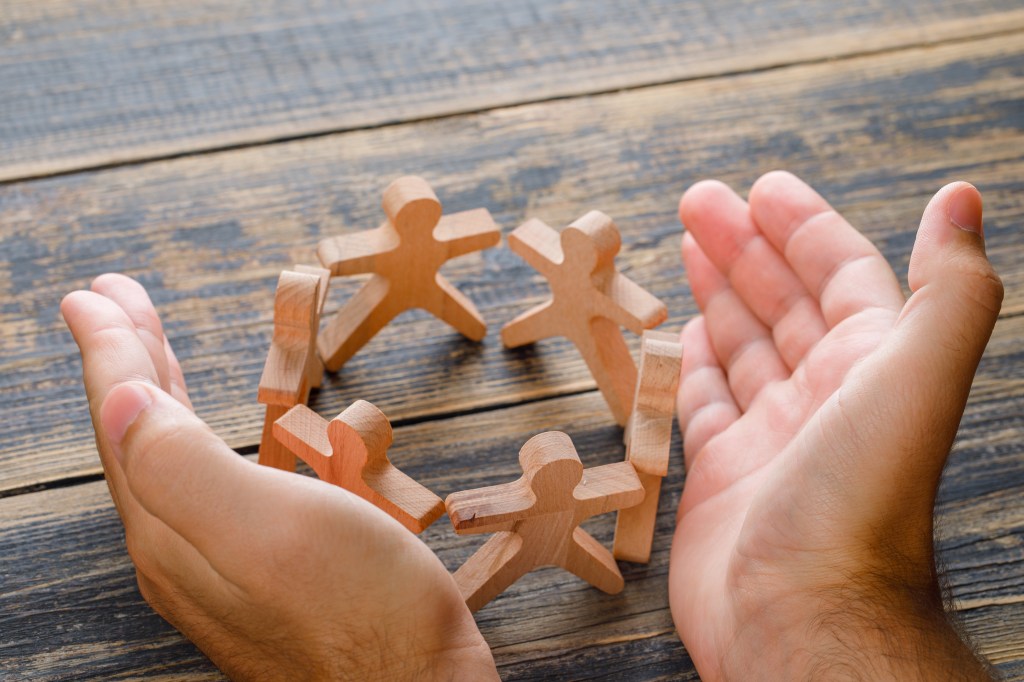
Business success concept on wooden background high angle view. hands protecting wooden figures of people.

As previously mentioned, community archives are wary of engaging with institutions, seeing them as gatekeepers which will keep them from their own records and store them for years without doing any work to make them accessible. This is generally due to lack of fund on the part of the institution but this is largely irrelevant to the group who have worked so hard to pull a collection together and feel really passionate about it’s topic. Approaching community groups is also challenging because, just like archives, no two are the same. Some have a wealth of archive knowledge and training programmes to help spread this throughout their teams. Some are individuals with true passion for the items they collect but no real understanding of the good practice required to preserve them long term. This is a particular problem with digital records, where storage is regularly confused for preservation and access via a website is a common form of ‘preserving’ records. 

So, what do we do? I would suggest we approach these groups ready to learn. Make it clear that we are interested in what they’ve been doing and are keen to help, but most importantly, help within their context. We are not the saviours of these collections as they have already been saved, but we can help with advice and guidance on what happens next. Offering collaboration over collections deposit for me is a good thing. If these collections can be preserved to the standards required for long term preservation within the community, then we should be facilitating that and helping to facilitate access and promotion rather than suggesting removal of the collection for cataloguing. Having a list of resources on hand will be a huge help in this work. 

Illustration of speech bubbles

It’s also important to show actual interest in the communities we want to connect with. Go to their events, have conversations about things other than archives and forge a connection that’s about more than work. I think if we can do this, we are a good way down the path of collaboration. Working together, for me, is the key to all archive work, and this includes working with other archivists and record practitioners. There is a wealth of hugely successful projects and work in this area already and learning from those who have done or are already doing it will really help improve our own practice. Let’s work together and move the sector forward in a new way that benefits us all and makes more collections accessible in new ways. It all starts with a conversation… 

Archives, Archivists, and Storytelling

From a personal perspective, this blog is quite a difficult one to write. Before I begin, I don’t think this is a black and white issue, but it’s been something that’s been percolating in my mind for a long time, so I thought it appropriate to bring it up here.

One of the key components of archives is their role in storytelling. Some of the best stories in the world are held in archives and with the digital technology sphere growing and expanding what feels like daily, there is a wealth of ways these stories can now be expressed, interpreted and told.

And when I qualified it was one of the aspects of the job that I was most looking forward to doing. I liked the idea of being able to research a collection I had just catalogued for the nuggets of interesting information I could share with the world. Every archive course across the UK includes an element of outreach and advocacy and the Explore Your Archive Campaign encourages us to tell the stories in our collections and show the world our treasures through the medium of storytelling. However, in the last 5 to 10 years, this has become problematic for me for several reasons.

Firstly, in every institution I’ve worked in, promotion of the collections has taken priority over the actual work I was hired to do – namely catalogue a collection and make it accessible. In project cataloguing roles I’ve been told to include less description or only catalogue to series level to ensure that time remains at the end of the project for promotion, whether that be online or via exhibitions. It never made sense to me how I could promote a collection well when I wasn’t entirely sure what was in it; and my title was project cataloguing archivist in some cases – Surely, I was hired to catalogue. The sector seems to me to have forgotten that the best way to promote a collection is a well laid out detailed catalogue that users can access, understand and interpret according to their research needs. In my mind what we should actually be promoting is the archive itself, the work being done and why it’s so important. We should be a gateway for discovery, not gate keeping what we think the most important and interesting parts of our collections are.

Secondly, the world has changed so much since I qualified that it’s changed the role (and in some ways perceptions) of the archive and the archivist too. The focus used to be on the collections held that were hundreds of years old, preserving them and telling the stories contained within them. I think this is still a core part of the job, but it’s been joined by a sharper focus on modern collecting. Having learnt from the gaps that exist in these older collections, archivists are now focused on making sure we collect a full representation of the world around us and that no voice is forgotten or left behind. This is a huge step forward and should continue as there is still improvement to be made in this area. However, in many cases, we still cling onto the notion that we are the best people to tell the stories held in modern collections and I believe we need to analyse this feeling. With modern collecting, many of the record subjects are still alive, and although our collecting will ensure they have a voice in the future – they still have their own voice now. With community archives, whole communities still exist which lived the truth described in the records we hold, and no one is more qualified to tell that story then them.

Perhaps with these collections, our role should be to facilitate storytelling, to make the collections easily searchable and accessible so the people who can see themselves within it are encouraged to use it and tell their story. Yes, exhibitions around collections from hundreds of years ago still have a place but are there scholars of the period who could interpret the records in a new way, or someone with ancestors from that period that has a particular link they could share. Oral histories can be collected and added to the collection to enrich it and create a range of perspectives for those who look at the collection many years from now. Surely that is the role of the archivist? To leave the most accessible, representative collections that we can for the future? Our advocacy work should focus on this and why the work we do is so important.

This is where the true value of the Explore Your Archive Campaign comes in. We shouldn’t be telling people what we think they should be interested in, or promoting the records that are our favourite from the collections. We should be saying this is what we do and this is why it matters and without it you wouldn’t have records like these. But there is no point in pointing out records which are only accessible via online exhibition because the catalogue was badly completed.

So for me, I’ve hung up my storytelling coat. I want to focus on making collections available for others to tell their own story. I was to help give a voice to those who may feel they’ve been forgotten and the last thing I want to do is gatekeep that experience. In the future, if where I’m working has no collections backlog (does anyone have this? Will we ever have this?) then research would be a nice to do job. But until then, advocacy and storytelling will remain separate. It’s not that I won’t promote what the archive I work in has, but it will be through a lense of archivist and not storyteller – because I’m an archivist and that’s what I am and I’m still very proud to be one.